
Three Pepin County Property Value Measures
Value questions in Pepin County often blur three figures that mean different things. An assessment supports tax administration. A market estimate predicts a sale. A deed amount records a past transfer. The county portal is the public route to property information, so verify each measure against what the live record for a parcel actually displays rather than assuming a field name.
| Value | What It Is | Where |
|---|---|---|
| Assessed value | Tax-system value for the parcel; exact portal field was not captured | County tax and assessment records |
| Market value | A current sale estimate; no Pepin portal market field was verified | Independent appraisal or market analysis |
| Last sale consideration | A recorded transaction amount if stated in the instrument | Recorded deed; live result field not captured |
| Land and improvement split | Potential assessment detail; sample card not available | Ask the local assessor or real property lister |
An assessed value exists for tax administration. A market appraisal estimates a likely current sale under stated conditions. A deed's consideration, when present, describes one past transaction. Pepin County's assessment ratio, ratio year, reassessment cycle, and recent value trend are not published in a public spot. The local assessor is the source for those. Never apply a generic statewide ratio to guess what a Pepin parcel should sell for.
Pepin County Assessed Value Fields
The Pepin County Public Tax Portal serves as a one-stop source. It combines property information with tax payment. The landing page requires guest sign-in, browser cookies, and pop-ups. No example property card appears on the open screen. So the exact labels must be confirmed in the live record. These cover assessed total, land, improvement, exemptions, year, and value history. Keep the tax year with the figure.
The county's online data warning deserves attention here. An assessment can be updated or corrected. It can also be shown for a different tax year than a recent sale. Ask the local assessor or Real Property Lister which record backs a value question. The treasurer prepares the municipal tax roll for a bill or credit. A number without its year or field name cannot support a fair parcel comparison.
Use the Pepin County Public Tax Portal for the current public property lookup.
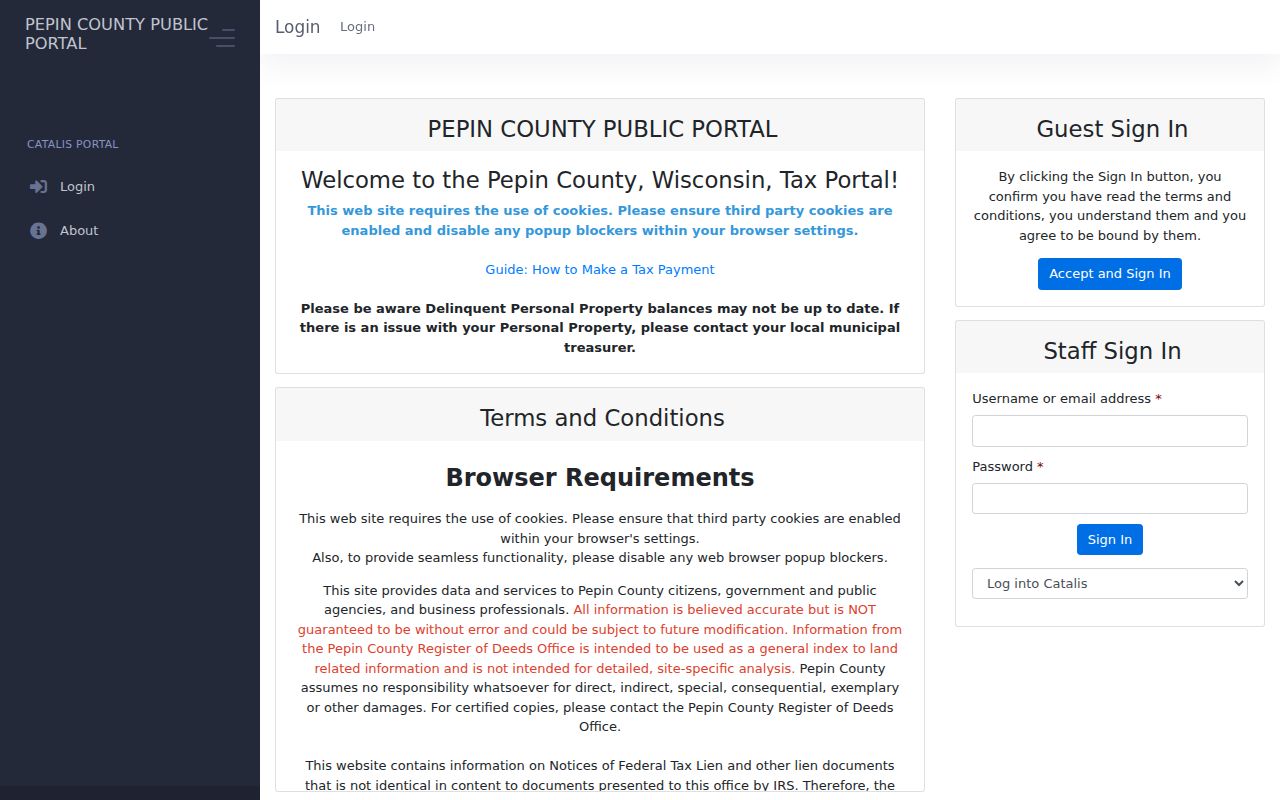
Record the parcel number, value field, and year together. That way a later reassessment cannot make two unlike entries look comparable.
Find a Pepin County Value Record
Finding a Pepin County property value starts with the parcel. Locate the parcel number first. Then identify the exact figure shown in the tax system. The live card's fields can differ from parcel to parcel. Do not assume a uniform layout. Keep the tax year and parcel key with any value you record. When a sale amount matters, inspect the recorded deed. Do not treat the tax number as sale evidence.
- Search the county Public Tax Portal by the available property method and note the parcel ID.
- Write down the value label and tax year exactly as the live result presents them.
- Check the recorded deed for a stated consideration or transfer reference, if a past sale amount is relevant.
- Ask the assessor about field meaning or the treasurer about tax-bill effects.
- Assessed value
- A value in the local tax assessment system.
- Market value
- An estimate of what a property may sell for under defined conditions.
- Sale consideration
- The amount stated in a recorded transaction when the instrument reports one.
- Assessment ratio
- A comparison of assessed value with a market benchmark; Pepin’s current local ratio was not located.
Pepin County Tax Credits and Property Value
The county treasurer maintains lottery credits and prepares tax bills for eleven municipalities. A credit can change what is owed. It does not change the land's market value. The full list of property-card exemptions rests with the assessor. The assessor also explains how each credit relates to the displayed value. Use the treasurer for a bill and the assessor for the value record.
Property tax records and property value records answer related but distinct questions. A tax bill reflects the charge and payment status in a year. An assessed amount drives local tax administration. A deed records a transfer. For exemptions, delinquency, or an appeal procedure, use the separate Pepin County property tax records page. The county sources state no assessment appeal deadline or board schedule. So verify the current process with the assessor.
Never subtract a credit from a value. Never treat a bill as evidence of market price. Keep each number attached to its record type and period.
Pepin County Sale Price and Deed Records
A recorded deed may state transaction consideration. No sample deed result shows a standard online sale-price field, so the Register of Deeds index is the place to check. Rely on the instrument itself and its recording reference. Deal terms and the date can shape a transfer amount, which is not automatically the current market value or a professional appraisal.
The Register of Deeds offers two online deed search tools. Tapestry EON serves occasional users as a pay-per-search index. Laredo suits daily users with a monthly subscription. Search the grantor and grantee. Request a copy when the image is missing. The county states no earliest online index year. The recorder can supply a document but will not run a title search or explain legal effect.
Use deeded acreage and the legal description as context for the transaction. Compare parcels only when location, land area, improvements, and sale date make them meaningfully similar.
Pepin County Acreage Is Not an Appraisal
Pepin County's GIS layer carries two acreage fields, GIS_ACRE and DEEDED_ACRES, and the two can disagree. One comes from mapped geometry. The other reflects the acreage stated in the deed. Neither one is a valuation. A riverfront parcel, a rural tract, a lot split, or a different improvement history may not compare cleanly with another parcel sharing the same mailing city.
The county treats parcel geometry as reference data that may contain errors. When an acreage gap affects a sale or a land-use question, read the legal description and the recorded CSM first. Then hire a licensed surveyor. A map area is not a market adjustment. A tax value cannot settle a boundary either.
Pepin County's assessor-value fields, assessment ratio, and revaluation year are not published online. Ask the local assessor which parcel characteristics the record includes before comparing values.
Historical Pepin County Land Value Clues
The Pepin Public Library's 1877 county plat names landowners, township statistics, and distances. It also includes a period business directory. It shows who held a tract and how the land was described at the time. It offers no modern sale appraisal or comparable value series. The library's 1886 map of Pepin village preserves unopened platted streets. It also marks a former park site. Mapped context changes over time.
To trace a property history, use these maps to locate a name. You can also find an old road. Then verify the current parcel in the county GIS and the recorded deed records. The Pepin County Heritage Center holds plat books and family records. Its research files build further context. Old ownership is not a reliable estimate of what the land would sell for today.
A value comparison needs the parcel, the year, and the record type. A supporting method must anchor the number too. Without those pieces, a number can look precise while answering the wrong question.
Limits of Pepin County Assessed Value
A Pepin County assessed figure is a tax record. It is not a guaranteed sale price, an offer, or a private appraisal. The county publishes no local assessment ratio or reassessment year online. The portal's sample value card and historic value trend are likewise unavailable. Do not fill those gaps with a statewide ratio or a neighboring county's cycle. Do not rely on a generic online estimate either.
Ask the assessor which year and method the record reflects. For a current market estimate, use a qualified appraiser or a market analysis with sound comparables. For a tax bill, credit, or review step, contact the treasurer. The assessor also handles such questions as appropriate. A property value record works best when its source and purpose stay attached to the number.
Value versus price. An assessed value is used for tax administration and is not what a Pepin County property will necessarily sell for. It is not a licensed appraisal.