
Search Pepin County Property Records
Where you begin a Pepin County property search depends on what you already have. An address works for a house or farm. Rural routes and mailing labels may spell it differently from the deed or the map. Once the tax portal or ArcGIS map hands you a parcel ID, that number becomes the best bridge between offices. An owner name can pull up several holdings. Trusts, estates, and limited liability companies complicate a name match, so expect some digging.
For recorded instruments, use the county's Public Tax Portal for property and tax information. Use ArcGIS for parcel geography. Use the Register of Deeds index for deeds and mortgages. The county's own notices call a portal result an index or reference. They never call it a title opinion. A map line is not a boundary survey either. Before a purchase, estate, tax question, or house history, compare the records across custodians. Request the filed document when a summary falls short.
- Enter the street address in the Pepin County Public Tax Portal, or locate the parcel on the county ArcGIS map.
- Copy the parcel ID, alternate PIN, address, and legal description that the available record shows.
- Use the parcel key and owner-name variants in Tapestry EON to find deeds, mortgages, plats, and related filings.
- Check the treasurer’s tax information and compare the mapped parcel with deeded acres and the legal description.
- Ask the custodian for an office copy when a document is absent online; request a survey for a boundary decision.
Offices Behind Pepin County Property Records
No single desk holds Pepin County property records. The Register of Deeds records deeds, land contracts, mortgages, plats, certified survey maps, federal tax liens, and other instruments. The treasurer builds the tax rolls for all eleven municipalities. The treasurer collects real-estate taxes, and links to delinquent-tax and tax-deed information. Real-property listing and parcel-description work feeds assessment data into the county's tax and mapping systems.
Durand is the county seat, so both the deed and court counters sit there. The Clerk of Circuit Court keeps the underlying court files. WCCA serves as the state's public case-summary portal. Village and city clerks hold their own minutes, permits, zoning files, and local agreements. Those municipal files add context. They still cannot replace the county deed or parcel record.
Pepin County Recorder / Register of Deeds
740 7th Ave W, Room 111
Durand, WI 54736
715-672-8856
Public Tax Portal
County property and tax lookup
Guest sign-in uses cookies and pop-ups
Pepin County Treasurer
Tax rolls for eleven municipalities
Delinquent-tax and tax-deed information
Pepin County Deed Index Access
The Register of Deeds is the legal custodian of any deed or mortgage in Pepin County. Its page lists Tapestry EON for occasional searches paid by credit card. Laredo serves regular users on a monthly subscription. Fidlar operates both portals rather than the county. The office publishes no stated start year for the online index. So an empty search never proves that an older document is absent.
Work the index from both sides of a transfer. A grantor conveys an interest; a grantee receives it. Try the current grantee's name as a grantor in the earlier deed. Search initials, spelling variants, and entity names too. A person may hold land through an LLC, trust, estate, or business. Write down the book and page or document number before moving to the next result.
Review the Pepin County Register of Deeds page for its current recording links and copy directions.
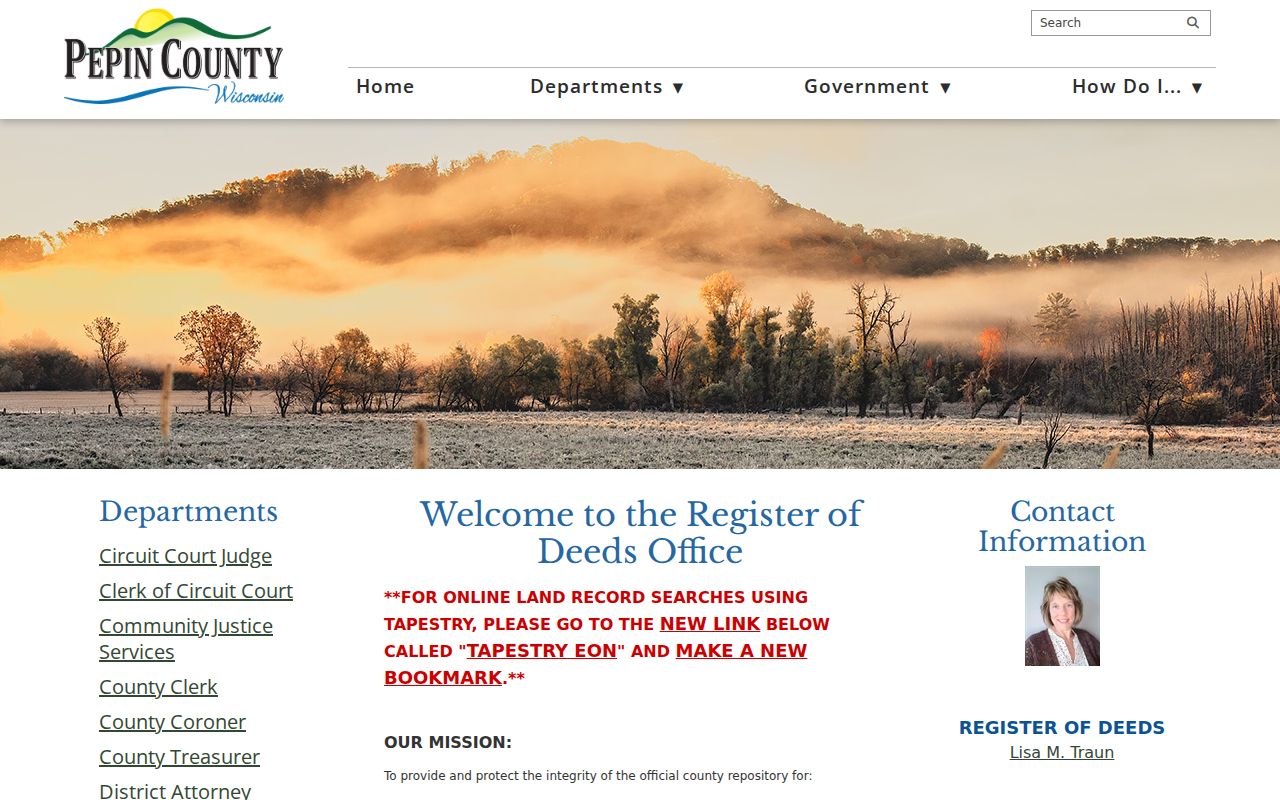
Ask the county office directly about a document that is missing online. It may also still be in processing. The staff will not run a title search or interpret an instrument. That limit is actually helpful. An index points to a filing. A title professional examines the chain and its legal effect.
Tax Information Across Pepin County
The Pepin County Public Tax Portal handles property lookup and tax payment in one place. Its instructions support property and tax-bill searches. The landing page requires a guest sign-in. It also calls for browser cookies and pop-ups. Some details are live-interface items to confirm on the spot. Field options, owner-name search, PIN format, and the historical tax-year range should not be assumed.
Keep tax data separate from the deed record. The treasurer prepares the tax rolls for all eleven municipalities. The office collects postponed or delinquent real-estate taxes. It also maintains lottery-credit and tax-deed information. The portal warns that data can change. Some personal-property delinquency balances may lag, so confirm any balance with the treasurer before a payment or closing decision.
Open the Pepin County Public Tax Portal to begin the property and tax lookup.
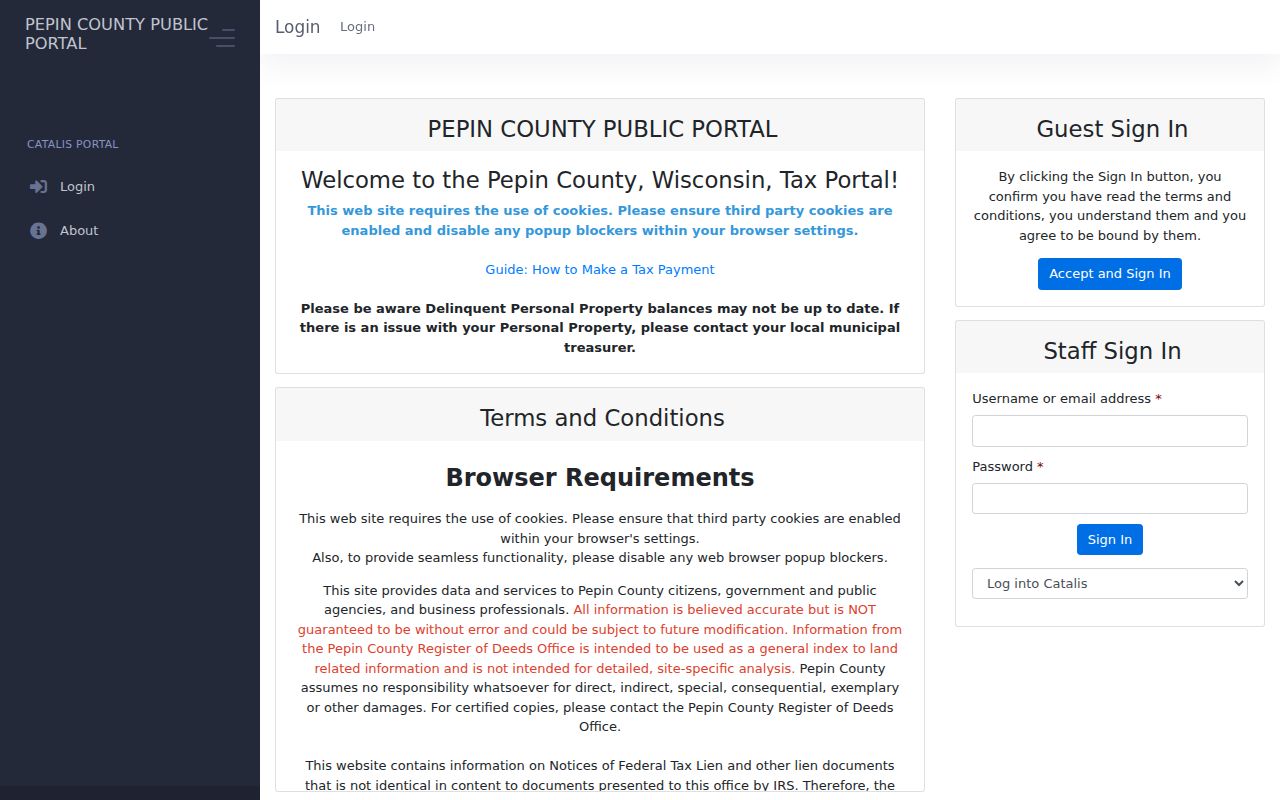
When a record appears, note its tax year and parcel ID. Then contact the treasurer to confirm any payment status or balance.
Pepin County Parcels on ArcGIS
The county's ArcGIS map gives Pepin County property records a visual shape. Each parcel appears as a clickable polygon. Behind the click sit tax-parcel attributes such as PARCELID, ALTPIN, GIS_ACRE, DEEDED_ACRES, PROPERTY_ADDRESS, and OWNER_LAST_NAME. The REST layer handles spatial queries. It exports several data formats. It also caps results at 2,000 records. Remember that a schema field is neither an assessor card nor a certified survey.
GIS acreage and deeded acreage rarely match exactly. So treat the two figures as cross-checks rather than competing truths. Pepin County itself warns that mapped layers can hold errors. It also notes that parcel lines are reference data. When a fence, an access path, or a sale hinges on the exact line, pull the legal description first. Pull the recorded CSM first, too. Then hire a licensed surveyor. The county surveyor reviews private surveys and settles survey conflicts. The office does not survey land for individual owners.
Open the Pepin County ArcGIS map portal to reach the county's interactive parcel map directly.
Find the spot on the map and write down the PIN. That number is your key to the tax portal and the recorder index.
Pepin County’s Ongoing Map and Deed Scans
The 2025–2027 Land Information Plan sketches real changes. It reshapes how people reach Pepin County property records. Register of Deeds documents keep moving into digital scans. High-resolution orthography is being replaced, mapping is being refined, and new tax pins are being assigned. The plan names several public routes. These include ArcGIS Online, the county Hub, Catalis tax tools, Tapestry, Laredo, and statewide parcel data. The work is ongoing. An older paper reference and a fresh online result may not line up perfectly.
Staff generally cannot build a custom file for every request. The plan steers people toward select downloads on the GIS Hub and statewide parcel data. Staff may share existing files in their current form. A downloadable layer is not automatically corrected or certified. Preserve the date and source of anything you use for research.
This transition argues for careful notes. Keep the original parcel ID, document reference, and map date beside every note. If an image is missing, ask whether a scan is still pending. An empty portal result is never proof that the record does not exist.
Historic Pepin County Land Clues
Old maps can solve puzzles that modern Pepin County property records cannot. The Pepin Public Library's 1877 county plat names landowners alongside township statistics, distances, and a period business directory. Its 1886 Village of Pepin street map shows streets platted but never opened. It places a park in an earlier spot. There is no railroad mark, despite the railroad arriving that year. These details help when an old deed or family note names a place that no longer exists.
The library also holds Town of Pepin records from 1857. They include voting lists, road orders, and personal-property lists. Newspapers run deep here. Pepin Herald issues span 1908 through 1964 with gaps. Pepin Laker covers 1965 through 1981, and later Courier-Wedge runs follow. A regional index of birth, death, marriage, and divorce notices covers roughly 1900 to 1950. All of this builds context around an address. The recorded deed still proves the transfer.
Browse the Pepin Public Library local-history collection for the plat, map, and newspaper sources cited here.
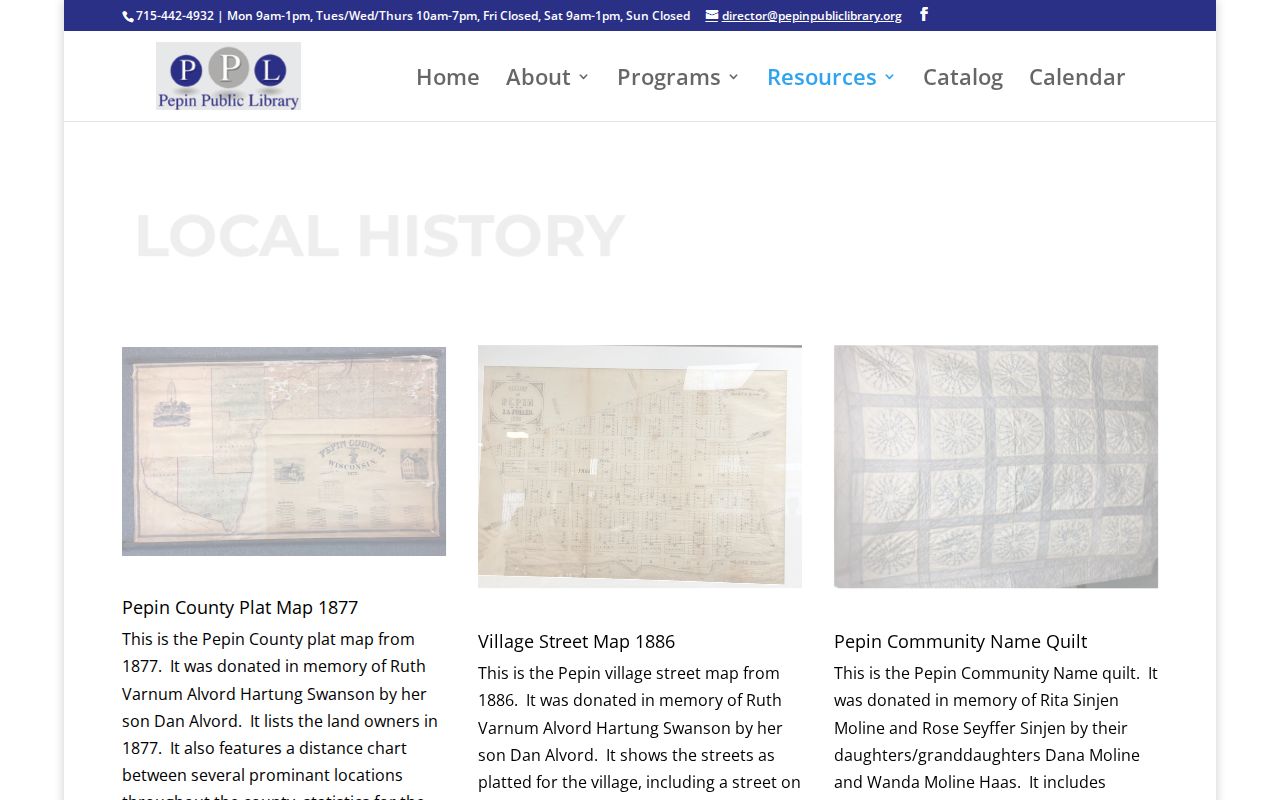
Roads and parks moved over time. Match the old map to the filed plat and legal description before trusting a modern polygon.
Pepin County Plat Books and Family Files
The Pepin County Heritage Center holds plat books, family histories, cemetery material, and museum files. It also holds digitized collections. Its research room shines when a named plat or family record resists an online search. So does its volunteer request service. The family-history index covers Bauer, Dorwin, Erickson, Brunner, Black, Dahlberg, and other area lines. A family file can hand you a surname or farm name. Try it in the recorder index.
Treat the Center as a history lead, then confirm ownership with a recorded instrument. A plat book is a snapshot of landholding, not a recorded subdivision plat. It is not a CSM, deed, or assessor card either. For the formal subdivision and CSM indexes, the county Register of Deeds is the office to ask. Its staff can explain how to request copies.
Rural holdings need precision. Pair the book or family clue with township, range, section, lot, block, and PIN details. That discipline keeps Pepin County property records tied to one specific tract. It holds even as names and addresses change.
Types of Pepin County Property Records
Different Pepin County property records answer different questions. A deed reports a recorded transfer. A tax roll reports assessed information and tax status. A parcel map places a tax parcel in county reference geometry. Court files can reveal a foreclosure or a lien dispute, while local permits and zoning decisions document municipal work rather than ownership.
| Record Type | What It Documents | Kept By | Access |
|---|---|---|---|
| Deeds and land contracts | Recorded transfer instruments and legal descriptions | Register of Deeds | Tapestry EON or office request |
| Mortgages and liens | Recorded encumbrances and later releases | Register of Deeds; court for cases | Index search and certified copy |
| Assessment and tax | Parcel values, tax bills, credits, and balances | Real property lister and treasurer | Public Tax Portal and office |
| Plats, CSMs, and parcels | Lot descriptions and mapped reference geometry | Register of Deeds and Land Information | Plat links, ArcGIS, Hub |
| Permits and zoning | Local approvals, inspections, and land-use files | City, village, or county custodian | Ask the clerk for existing records |
Match the record to the question. For title history, work the deed index and the filed documents themselves. For the current tax position, open the treasurer's portal and confirm which year it displays. For boundary lines, hire a licensed surveyor. Lean on recorded survey material too. Search Pepin County property records as a body of evidence, not as one all-purpose database.
Pepin County Property Fraud Alerts
Pepin County landowners can enroll in a free Property Fraud Alert service. It comes through the Register of Deeds. It sends an email, text, or phone notice. The notice goes out whenever a name you register appears in a recording. It will not block a filing. It also does not insure title or vouch that a record is false. So compare any notice with the recorded instrument itself. Ask the office about any unfamiliar document number.
The county also links Notary Fraud Alert for notaries. A letter may arrive selling an overpriced deed copy of your deed. A caller may even demand money to join a service that costs nothing. Scams circle the program. Verify senders through the county's own Register of Deeds page, never a number printed in a message. Keep your parcel ID and recording reference ready when asking the office to check a filing.
Read the Property Fraud Alert service details before you enroll in recording notices.
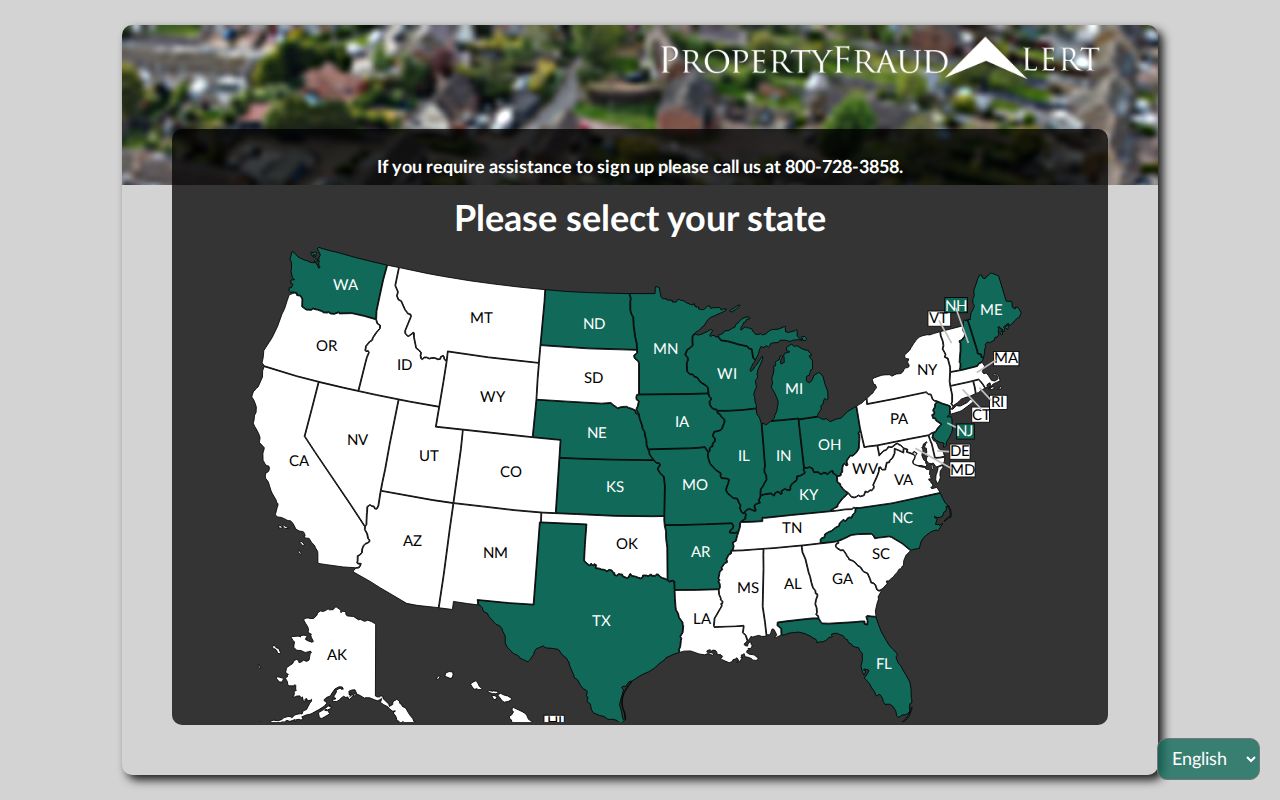
A notice is not a legal finding. It simply prompts you to check the public record behind any deed or name it flags in Pepin County.
Pepin County Property Court Records
Property disputes in Pepin County go to Circuit Court. Foreclosure, quiet title, partition, lien enforcement, probate, and property judgment matters all land there. Wisconsin Circuit Court Access, known as WCCA, offers a case-summary route by party or case identifier. A summary may list the case number, filing date, case type, parties, status, disposition, and event entries. WCCA does not show document images. The clerk keeps the underlying file.
For a title question, ask the Clerk of Circuit Court about the file itself, not just the online summary. A lis pendens signals a claim. So does a foreclosure filing. Neither proves that ownership changed. Request the judgment, notice, order confirming sale, satisfaction, or probate transfer by case number. The clerk's office, at 740 7th Ave W in Durand, can explain inspection and copy steps. The clerk cannot give legal advice.
Use Wisconsin Circuit Court Access to locate a public case summary before contacting the Pepin County clerk for the underlying file.
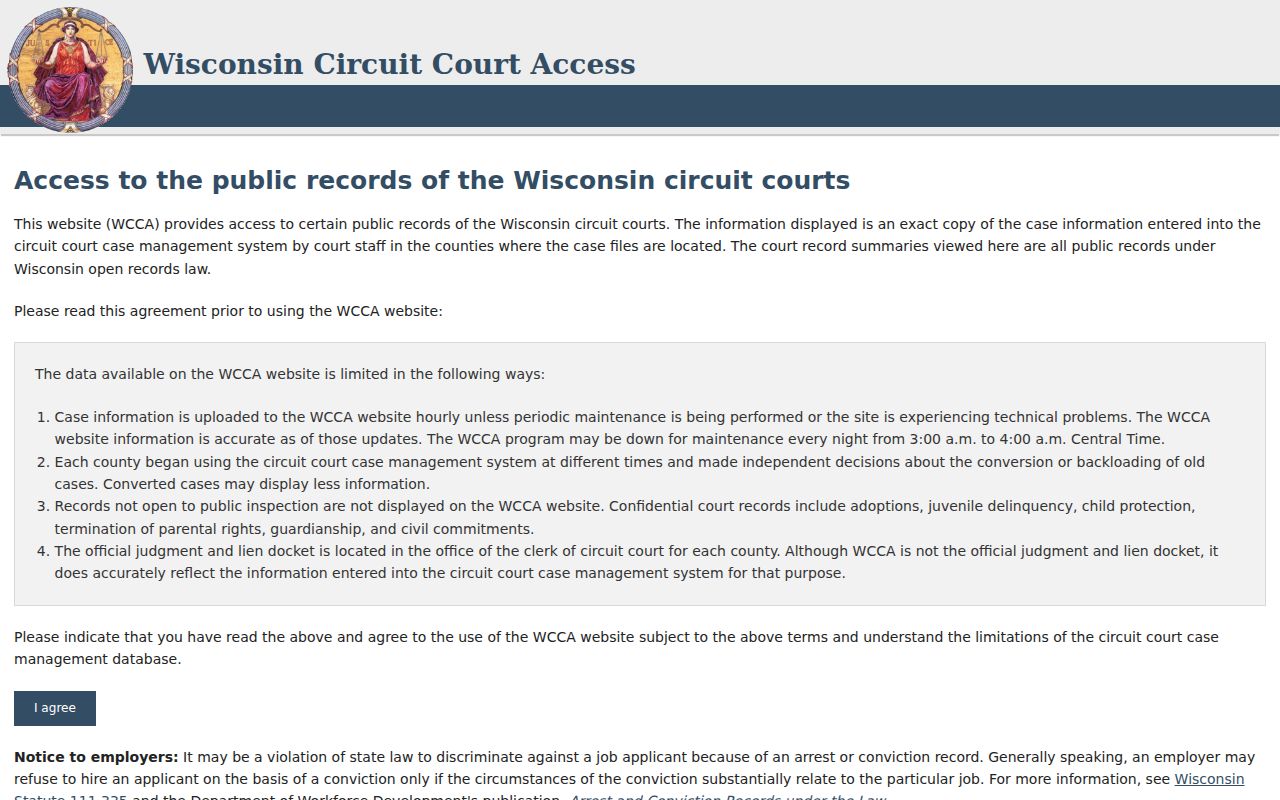
Municipal courts handle ordinance and traffic cases. They are no substitute for the circuit-court record of a Pepin County property claim.
Requesting Pepin County Public Records
Wisconsin's Public Records Law, Wis. Stat. §§19.31–19.39, leans toward disclosure of records the government already holds. That applies to Pepin County offices as much as any other agency. A request may be oral or written. Written works better. It creates a paper trail and spares everyone confusion. Include the office name, the parcel number or document number, the address, and a date range. The custodian can then find the material fast.
Ask to inspect a record first if a copy is not needed. Inspection is usually cheaper. The custodian may charge reasonable, permitted costs for reproduction and for locating the material. The agency is not required to build a new report out of its files. Routing matters, too. A recorded instrument that is not online belongs with the Register of Deeds. An existing tax record goes to the treasurer. A case file goes to the circuit clerk. A permit or local minute goes to the municipal clerk involved. When an office cannot fill a request, ask which custodian most likely holds it.
Some material stays closed even though Pepin County land records are public. Protected vital information does not open up just because a deed does. Sealed court material, protected-victim addresses, and certain personal identifiers stay closed, too. For historical context around a Pepin address, try the countywide record set. It pairs well with the Pepin village records and map history. A county search still rests on a parcel number, a legal description, or a recorded document. That document pins down the land in question.
Limits of Pepin County Property Records
Pepin County public records show what an office has actually recorded or assessed. They have edges. A grantor-grantee index may miss a document still in processing, the public tax portal warns that its information can change, and the county's federal tax-lien index may not match IRS filings. WCCA case summaries are summaries, not the full clerk file. When status matters, ask the custodian for the controlling copy.
A record search is not a title opinion. It is also not a survey or an appraisal. Parcel lines on a map are reference geometry, while the recorded legal description and a licensed survey answer the real boundary questions. A tax assessment is a tax figure, never a promise of sale price. Keeping those limits in view makes Pepin County property records far more dependable for a purchase, family history, tax review, or civic research.
Lawful use. Pepin County property records support property research, purchase diligence, tax review, and civic transparency. A record search is not a title opinion or survey, and owner information must never be used to stalk, harass, threaten, or harm anyone.